Cracking the Egg
| by Georgina Adam |
Some unanswered questions surround the sale of the Fabergé trophy piece
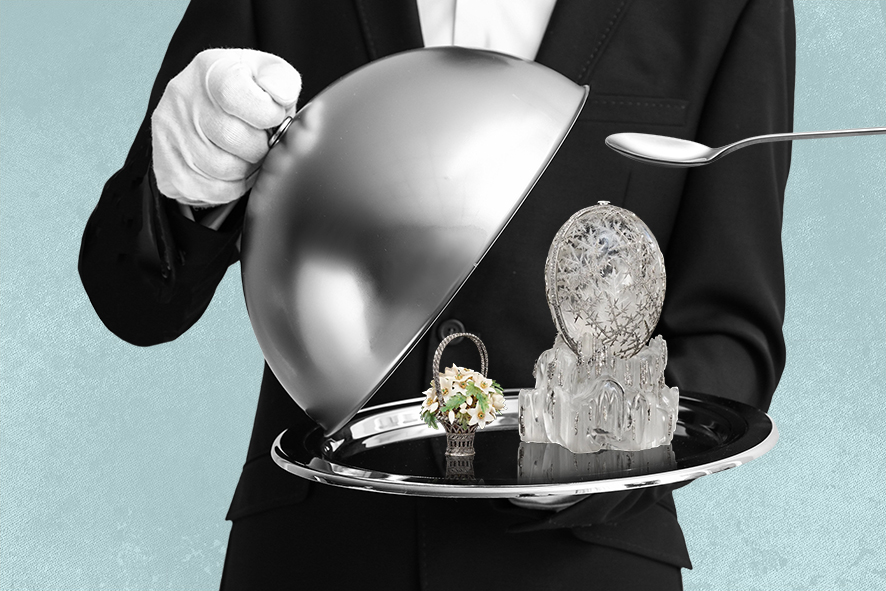
At Christie’s on 2 December Fabergé’s Winter Egg—the ultimate example of Russian imperial excess— sold for a cracking £22.9m. The 14 cm-high piece is studded with 4,500 diamonds and conceals a tiny basket of bright flowers inside its icy exterior: this was the third time it set an auction record for any work by Fabergé.
It sold to the London dealers Wartski, who immediately posted on Instagram that it was “returning to the Wartski nest after over 100 years”.
Kieran McCarthy, the co-managing director of the firm, confirmed to me that he was the successful bidder in the room, encouraged (he said) by his dog Drummer. “It was an absolute bargain price, because now was the worst possible moment to sell the egg,” he said. “And it indeed went well under the unpublished estimate of £20m-£30m [which did not include fees]. We didn’t buy it for a client, but for trade,” he added.
Why was it such a bad moment? “It couldn’t sell to Russia, which is of course prohibited, and indeed Christie’s apparently rejected several potential bidders before the sale. And an American buyer would be paying a stiff tariff now,” McCarthy explained. Christie’s noted that online and in the saleroom it pointed out: “We remain committed to complying with all relevant sanctions laws, including any applicable luxury goods prohibitions, and all relevant AML regulations.”
The egg last sold for £8.9m in 2002. The buyer then was Sheikh Saud Al-Thani of Qatar, who was at the time the world’s biggest art buyer and was avidly—even obsessively—buying in different fields, including antiquities, photography, natural history, Islamic art, art deco and even vintage bicycles. But in 2005 he was accused of misappropriating government funds and briefly placed under house arrest.
Sheikh Saud died in 2014 aged just 48, and apparently the egg went to his family, who might have been the sellers this month—unless it had already gone to another owner. Along with the Winter Egg, another 47 lots of Fabergé items were on the block, all from the same “princely collection”. Christie’s was not to be drawn further about the seller, of course, nor was McCarthy, although he did say that the guarantee on the egg was given at the “last moment” and that he was not the guarantor.
The Winter Egg has a fascinating back story. Made in 1913 for Emperor Nicholas II, it left Russia after the 1917 Revolution, when the Soviets nationalised vast art collections from palaces and churches, then sold them abroad to buy machinery, a campaign known as “treasures for tractors”.
It was acquired by Wartski for £450 between 1929 and 1933, when the average wage was around £55 per year. Wartski sold it to the Third Lord Alington, or “Naps”, who was described by one biographer as “well cultivated, bisexual, with sensuous, meaty lips, a distant, antic charm, a history of mysterious disappearances, and a streak of cruelty.”
The egg itself also disappeared for a time, then reappeared at auction twice before the 2002 sale. Persistent rumours hold that it was never paid for in 2002. Neither Christie’s nor Wartski would comment, but Sheikh Saud did leave a trail of other debts at his untimely death.
Everyone agrees on one thing. “It is without doubt the towering masterpiece of the Imperial Eggs, it is gasp-makingly beautiful,” said Geoffrey Munn, a Fabergé specialist and formerly of Wartski, while McCarthy added: “It is simply the greatest Russian work of art ever.”
11 December 2025